
How to Identify Fake Pokémon Cards: 7 Signs
Table of Contents
- Start With the Card Back and a Known Authentic Example
- 7 Fake Pokémon Card Signs You Can Check in Under a Minute
- Holographic Pattern, Foil Treatment, and Surface Finish
- Card Stock, Thickness, and the Bend Test
- A Pokémon Card Authenticity Check That Won't Damage the Card
- How to Spot Counterfeit Pokémon Cards When Buying Online or at Shows
- What to Do With Fake Pokémon Cards After You Confirm One
- Conclusion
- Frequently Asked Questions
Last Updated: October 20, 2026
Start With the Card Back and a Known Authentic Example
The fastest way to learn how to identify fake Pokemon cards is to compare a suspect card against one you know is real. Counterfeiters copy the front art well. The card back is where they slip.
Pull out a card you pulled from a sealed pack yourself. That card is your reference point.
Lay both cards face down on a table. Look at the back first. The blue border should be deep and even. The Poké Ball should sit dead center with crisp edges. Fake backs often look washed out, slightly purple, or too bright.
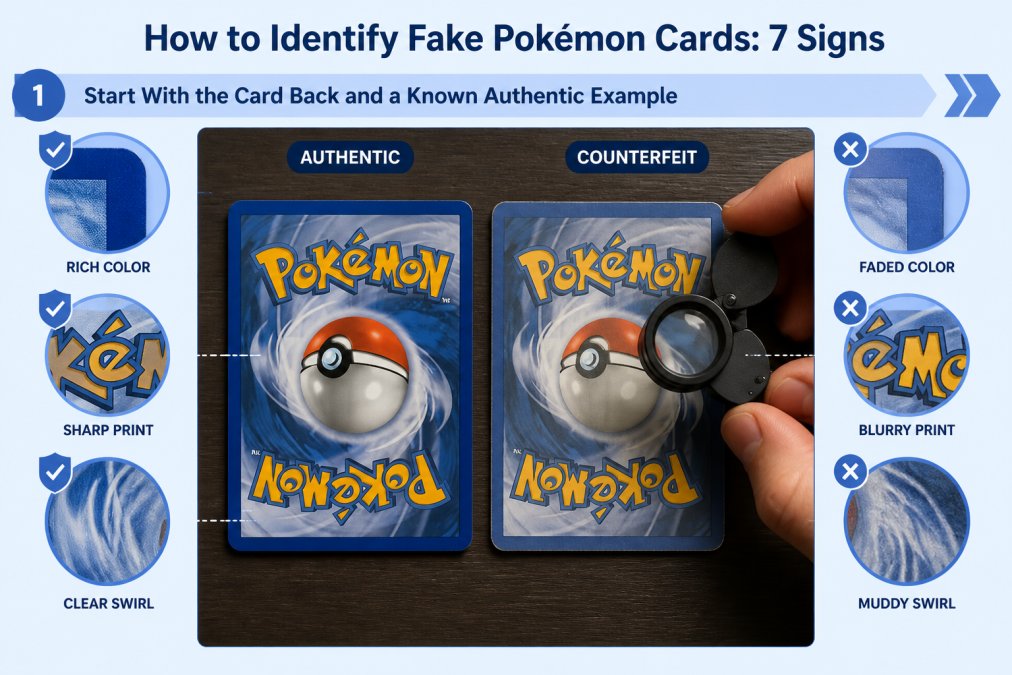
A few things to check on the back:
- Blue tone: real cards use a rich navy blue, fakes lean purple or faded
- Poké Ball lines: sharp and clean on real cards, blurry or thick on fakes
- Border width: even all the way around on a real card
- Paper feel: real backs have a slight matte texture, not slick plastic
This comparison method is the backbone of any Pokémon card authenticity check. Get the back right, and you filter out most fakes before you look at anything else.
7 Fake Pokémon Card Signs You Can Check in Under a Minute
These seven fake Pokémon card signs cover the details counterfeiters get wrong most often. Run through them in order, fastest to slowest.
Color, Saturation, and Print Quality
Real cards have rich, balanced color. Fakes look off. Hold the card under bright light and check for muddy shadows or blown-out highlights. Look for pixelation in the artwork and ink that smears at the edges.
A common mistake is judging color under warm indoor bulbs. Use daylight or a neutral lamp.
Text, Spelling, Punctuation, and Accent Marks
Read every word on the card. Counterfeiters miss small things:
- Misspelled Pokémon names
- Missing or wrong accent marks (Pokémon has one)
- Wrong punctuation in the flavor text
- HP numbers in the wrong font weight
Real cards use clean, consistent type. If a letter looks fuzzy or the spacing feels uneven, slow down.
Fonts, Symbols, and Energy Icons
The font on real cards is specific and consistent. Fakes use generic fonts that look close but not exact. Check the energy symbols in the attack cost. Real symbols are sharp and evenly sized. Fake symbols look thick, blurry, or slightly wrong in shape.
The set symbol near the bottom should match the set. A mismatched symbol is a red flag.
Borders, Alignment, and Centering
Real cards are cut with precision. Borders should be even on all four sides. Centering matters too. If the art sits far off-center or one border is much thicker, that's a warning sign.
Printing errors happen on real cards, so a slightly off-center card isn't proof of a fake. But a badly misaligned border combined with other issues usually means counterfeit.
Holographic Pattern, Foil Treatment, and Surface Finish
Real holofoil has depth. Tilt the card in the light and the pattern should shift and sparkle in a controlled way. Fakes either look flat or overdo the shine with a cheap sticker-like foil.
Run your fingertip lightly across the surface. Real cards feel smooth with a slight texture. Fake foil often feels raised or tacky.
Check the foil layer for the set's specific pattern. Different eras used different holo styles, and counterfeiters rarely match them exactly. Surface finish on the whole card should be even. Patchy shine or dull spots point to a fake.
Card Stock, Thickness, and the Bend Test
Card stock is one of the harder things to fake well, but it is also one of the easiest things to misjudge. Real Pokémon cards use a specific paper stock with a known thickness and a light paper texture.
Start with a stack comparison. Place the suspect card between two known real cards from the same set and press the stack flat.
The bend test is the most misunderstood check in this hobby. It is popular because it is fast, but it is also the check most likely to damage a card or produce a false result.
A safer alternative to the bend test is a thickness measurement. A digital caliper, available for under $30 at most hardware and craft stores, lets you measure card thickness without flexing it.
POKEMON 2 PACK BLISTER GENGAR, TEAM ROCKET'S MIMIKYU & MARSHADOW PROMO →
A second safe alternative is the light test, covered in the next section. It reveals stock density without any flexing, and it is far less likely to damage a card than bending.
A Pokémon Card Authenticity Check That Won't Damage the Card
The safest checks come first, and the most reliable checks are not always the ones collectors reach for first. Build a testing hierarchy so you never risk a card you might keep, and so you know which results to trust when the clues conflict.
Here is the order most experienced authenticators use, ranked from most reliable and least destructive to least reliable and most destructive:
- Side-by-side comparison with a known authentic example from the same set and era. This is the single most reliable at-home check. Printing, foil, borders, and stock vary by release, so a comparison card from a different era can produce a false positive. Match the era whenever possible.
- Visual inspection with a loupe or bright light. A 10x jeweler's loupe, available for under $15, reveals print dot patterns, edge sharpness, and foil texture that the naked eye misses. Look for halftone dots that are too large or too uniform, and for edges that are fuzzy rather than cleanly cut.
- Text and font verification against a known authentic card. Counterfeiters miss small things: accent marks, punctuation, HP font weight, and set symbols. Read every word and compare letter shapes side by side.
- Light test. Hold the card up to a bright light and check transparency. Real card stock blocks light differently than cheap fakes. A real card should look mostly opaque. If light passes through easily, be suspicious, but note that some legitimate cards are thinner than others, so compare against a known real card from the same era.
- Caliper thickness measurement. A digital caliper under $30 gives you a number instead of a feel. Measure the suspect card and a known real card at the same point and compare.
- Surface and texture check with a light fingertip pass. Real cards feel smooth with a slight texture. Fake foil often feels raised or tacky. This check is useful but subjective, so treat it as supporting evidence rather than proof.
- Bend test last, and only with gentle pressure. This is the least reliable and most destructive check. Use it only after the safer checks have pointed toward a fake, and never on a high-value card.
One clue is rarely conclusive. A slightly off-center card can be a legitimate printing error, and a card that feels thin may simply come from a different release. The hierarchy matters because it tells you when to stop: if the first three checks all point toward authentic, the card is probably real, and the riskier checks add little.
Photograph the card front and back under even daylight before you handle it much. Photos give you a record, and they let you compare details later without touching the card again. Include a close-up of the set symbol, the holo pattern, and the card back in your photo set.
When the hierarchy leaves you uncertain, that is the signal to seek an informed second opinion. Compare against verified cards from a reputable dealer, or submit the card for professional review if the value justifies the cost. At-home authentication is a filter, not a verdict, and knowing when to stop testing is part of the skill.
How to Spot Counterfeit Pokémon Cards When Buying Online or at Shows
Buying in person lets you inspect. Buying online means you rely on photos and the seller's track record. Both have traps.
When buying online:
- Ask for clear, well-lit photos of the front and back
- Request close-ups of the holo pattern and the set symbol
- Check whether the seller shows the same card in every photo
- Be wary of prices far below market for a rare card
At shows, inspect before you pay. Bring a known real card and a loupe. Sellers who know their stock won't mind.
Counterfeit booster packs and sealed products exist too. Check the crimp seals, the wrapper print quality, and the pack weight. Loose, uneven seals and blurry wrapper text are warning signs.
For official guidance on spotting fakes, the Pokémon Company support page on counterfeit products is worth a read.
What to Do With Fake Pokémon Cards After You Confirm One
Once you're sure you have fake Pokemon cards, don't pass them on. That's how fakes spread.
Here's what to do with fake Pokémon cards:
- Contact the seller and ask for a refund
- Report the listing to the marketplace
- Keep the card out of your collection so it doesn't get mixed in
- Mark it clearly if you keep it for reference
If you bought with a credit card, your card issuer's dispute process may help. The Federal Trade Commission guide to online shopping and refunds explains your rights when a seller ships something not as described.
The best defense against fakes is buying from sellers who source carefully and stand behind their stock. That's the standard we hold ourselves to at LexMar Collectibles Inc.
Conclusion
Spotting fakes takes practice, and even careful collectors get fooled sometimes. Start with the card back, compare against a known real card, and work through the seven signs before you spend money on anything rare.
When you're ready to add authentic cards to your collection, we're here to help. LexMar Collectibles Inc stocks curated Pokémon boxes, including our POKEMON SCARLET & VIOLET JOURNEY TOGETHER BOOSTER BUNDLE and exclusive items, all sourced with collectors in mind.

Add to cart and collect with confidence.
Frequently Asked Questions
How do you know if Pokémon cards are real?
Compare the card against a known authentic example from the same set. Check the card back first: the blue border should be even, the Poké Ball should be sharp, and the text should be crisp. Then run a Pokémon card authenticity check on the front: color saturation, font weight, energy symbols, centering, and the holofoil pattern. Real cards have clean edges, consistent print quality, and no spelling errors. If several checks fail at once, treat the card as counterfeit.
What do fake Pokémon cards look like?
Most fake Pokémon cards show obvious fake Pokémon card signs once you know where to look. Colors look washed out or oversaturated, text is blurry or has misspellings and missing accent marks, fonts are wrong for the era, borders are uneven, and the holo pattern looks like a flat rainbow sticker rather than a layered foil. The card stock often feels thin or glossy, and the card may be slightly off in dimensions or flexibility.
Can you tell if a Pokémon card is fake by comparing it with a real one?
Yes, and it is the single most reliable at-home method. Place the suspect card next to an authentic card from the same set and era. Compare the card back color, the font weight on the name and HP, the energy symbol shape, the set symbol, and the collector number. Differences in color temperature, text sharpness, or border width are strong indicators. Use good lighting and a loupe for the text comparison.
What should you do if you think you bought a fake Pokémon card?
Stop the transaction and document everything: photos of the card, the listing, and the packaging. If you paid with a credit card or a platform with buyer protection, open a dispute and describe the counterfeit signs you found. Contact the seller first and request a refund. Do not resell the card, and do not try to pass it off as real. Report the listing to the marketplace. Keep the card out of your collection so it does not get mixed in with authentic cards.